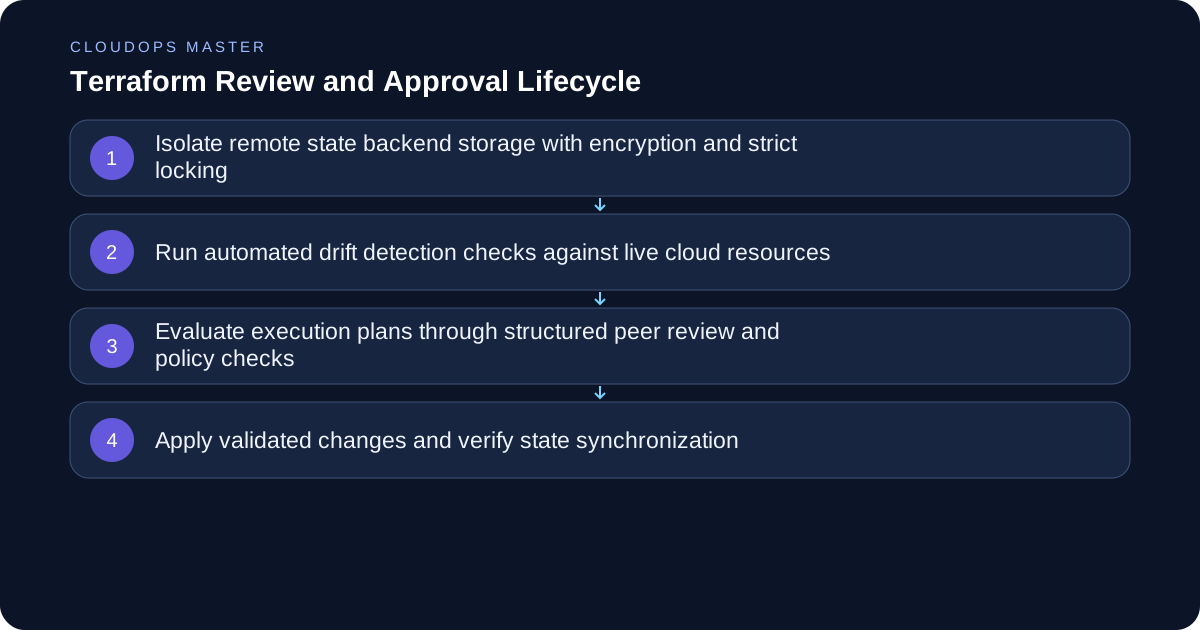
Managing infrastructure as code at scale requires disciplined control over execution states, continuous tracking of out-of-band changes, and rigorous review processes. As SaaS environments expand, unmonitored updates made directly via cloud provider consoles quickly introduce severe configuration drift. This article outlines practical engineering strategies for stabilizing state storage, handling concurrent execution safely, and enforcing peer reviews before any production modification reaches deployment.
Securing Remote State and Concurrency Controls
The foundation of reliable infrastructure automation lies in how and where state files are stored. Local execution states invite race conditions, shared secret leaks, and irrecoverable team bottlenecks. Production setups demand remote backends configured with encryption at rest, strict bucket-level access control lists, and native state locking mechanisms.
State locking prevents two concurrent runs from writing conflicting graph updates simultaneously. When teams skip native locking features or configure misaligned lease timeouts, partial applies corrupt the dependency tree. Ensuring that every workspace relies on a robust object storage backend with consistent locking guarantees eliminates silent data loss and provides a single source of truth for all resource mappings.
Detecting and Reconciling Infrastructure Drift
Configuration drift occurs when live cloud resources diverge from the declared state definitions. Manual hotfixes, emergency console interventions, and third-party automation tools frequently alter resources without updating the underlying repository code. Identifying these discrepancies early prevents unexpected resource replacement during routine deployment cycles.
Running regular, non-destructive execution checks against live environments highlights unexpected changes before they impact application traffic. When drift is detected, engineers must evaluate whether the live resource represents an intended hotfix that should be imported back into the configuration or an unauthorized mutation that requires immediate reversion. Blindly applying code over drifted resources often triggers cascading deletions or unexpected downtime for critical SaaS workloads.
Designing High-Signal Change Approval Workflows
Automated CI/CD pipelines streamline deployment frequency, but unreviewed plan outputs introduce profound operational risk. A robust change approval workflow relies on parsing textual execution plans into human-readable summaries that highlight destructive actions, such as database drops or security group closures.
Effective gating requires mandatory peer reviews on execution plans rather than simple code commits. Reviewers should examine resource dependency graphs, check for accidental replacements, and verify that tag conventions and networking boundaries remain intact. Teams must balance speed with safety by reserving strict multi-person sign-offs for production tiers while allowing automated approvals for isolated staging sandboxes.
Handling State Restructuring and Workspace Splits
As systems scale, monolithic state files eventually become performance bottlenecks. Large dependency trees slow down refresh phases and increase the blast radius of minor syntax errors. Migrating resources between separate state files using state move commands requires precise sequencing to prevent dangling references or accidental resource destruction.
Before executing state refactoring, teams must back up existing state payloads and run dry-run validations in isolated test environments. If a workspace split fails halfway through, restoring the previous snapshot prevents orphan resources from lingering in cloud accounts. Understanding how provider aliases and module boundaries interact during state migrations ensures structural changes proceed without interrupting continuous delivery.
Production Infrastructure Review Checklist
- Confirm that all remote state backends enforce encryption at rest and in transit.
- Verify that native state locking mechanisms are active to prevent concurrent execution conflicts.
- Schedule automated, read-only drift detection scans to run ahead of scheduled release windows.
- Enforce mandatory peer reviews on every generated execution plan before apply commands run.
- Maintain documented recovery procedures for corrupted state files and accidental resource deletions.
Conclusion
Maintaining a resilient infrastructure requires treating Terraform state files and execution workflows with the same rigorous engineering standards applied to application source code. By enforcing strict remote backend controls, systematically identifying infrastructure drift, and gating changes behind meaningful peer reviews, engineering teams can eliminate silent configuration decay and scale their SaaS operations with confidence.