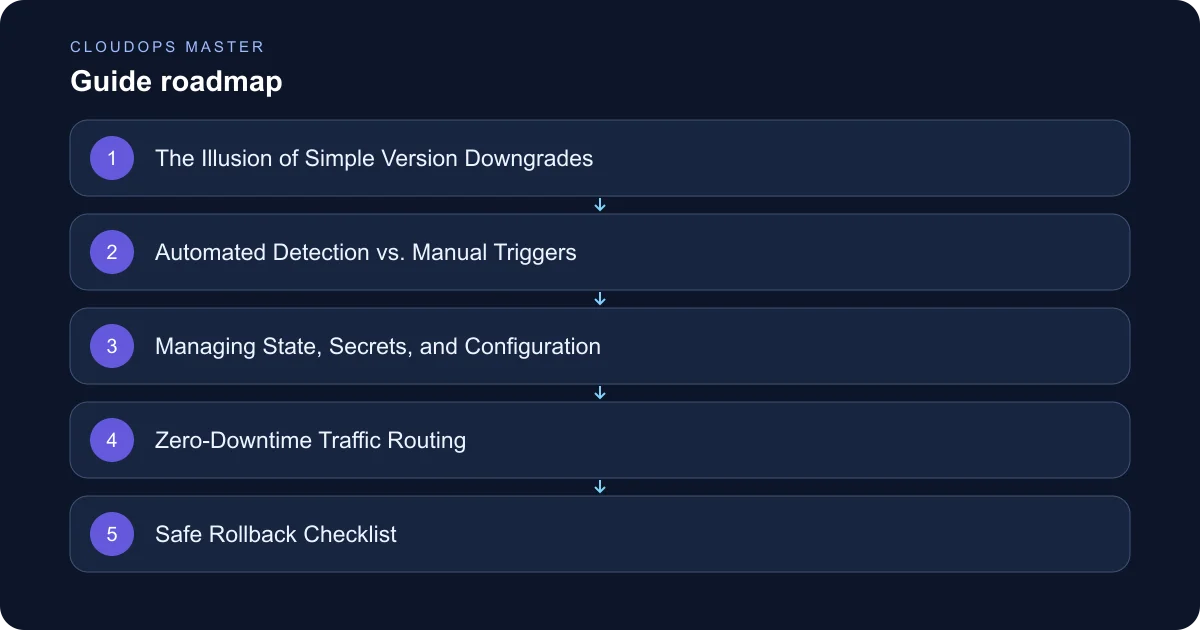
Deploying software continuously is a standard practice for modern SaaS teams, but deploying new code safely is only half the battle. When a deployment introduces a critical regression, the speed and reliability of the rollback mechanism determine whether the incident becomes a minor blip or a multi-hour outage. Designing safe rollbacks requires looking beyond simple version downgrades to address database migrations, state management, and configuration drift.
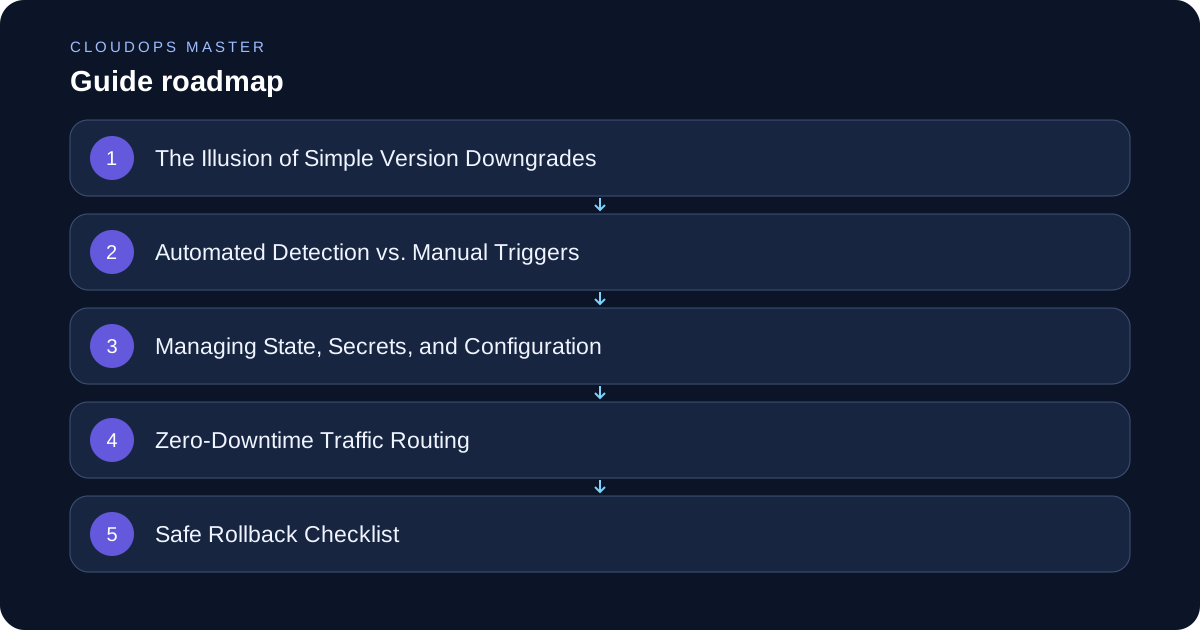
The Illusion of Simple Version Downgrades
Many engineering teams assume that rolling back a deployment is as simple as triggering the CI/CD pipeline to deploy the previous container image or artifact. In reality, modern applications are distributed systems with external dependencies, asynchronous workers, and persistent data stores.
If a new code version alters the schema of a database table, reverting the application code to an older version can cause runtime exceptions because the older code may not understand the new column structures or constraints. A safe rollback strategy must account for database backward compatibility. This means embracing expansion and contraction patterns for schema changes, where database updates are split into distinct, backward-compatible phases before application code changes are shipped.
Automated Detection vs. Manual Triggers
Deciding when to roll back is often harder than executing the rollback itself. Relying solely on manual intervention leads to wasted time during high-stress incidents as engineers debate whether to roll back or patch forward.
Effective pipelines integrate automated guardrails directly into the deployment phase. These guardrails monitor critical application telemetry, such as error rates, latency percentiles, and HTTP 5xx responses. If error rates exceed a predefined threshold within a specific evaluation window, the pipeline initiates an automated rollback.
However, automation is not always appropriate. For complex SaaS platforms with intricate distributed state, automated rollbacks can sometimes exacerbate underlying database issues. Teams must evaluate their system complexity: if a rollback could corrupt transactional data, a manual approval gate backed by clear telemetry dashboards is safer than blind automation.
Managing State, Secrets, and Configuration
Application code is only one component of a deployment. Infrastructure-as-code configurations, environment variables, and feature flags also change during a release cycle.
A robust rollback system must handle configuration state alongside binary artifacts. If a deployment fails due to a misconfigured environment variable, rolling back the application binary without reverting the environment variable will leave the system in a broken state. Decoupling configuration changes from code deployments using centralized feature flags allows teams to mitigate many production issues simply by toggling a flag off, bypassing the need for a full pipeline rollback.
Zero-Downtime Traffic Routing
Executing a rollback should never cause additional downtime for end users. Using progressive delivery techniques such as blue-green deployments or canary releases simplifies the rollback process significantly.
Instead of terminating running instances and replacing them, traffic can be shifted gradually between deployment slots. If anomalies are detected during the canary phase, the load balancer or ingress controller routes traffic back to the stable baseline version instantly. This approach avoids cold-start latency issues and ensures that active user requests are not abruptly terminated.
Safe Rollback Checklist
- Implement backward-compatible database migrations using the expand-and-contract pattern.
- Separate feature flags and configuration updates from monolithic code deployments.
- Define clear automated trigger thresholds for error rates and latency.
- Ensure load balancers support instant traffic shifting for quick baseline restoration.
- Test rollback procedures regularly in staging environments under simulated load.
- Maintain audit logs for every rollback action to assist post-incident reviews.
Conclusion
Designing safe rollbacks in a CI/CD pipeline requires a shift in mindset from treating deployments as isolated events to managing continuous state transitions. By anticipating schema incompatibilities, decoupling configuration changes, and implementing reliable traffic routing strategies, engineering teams can minimize downtime and maintain user trust during production incidents.