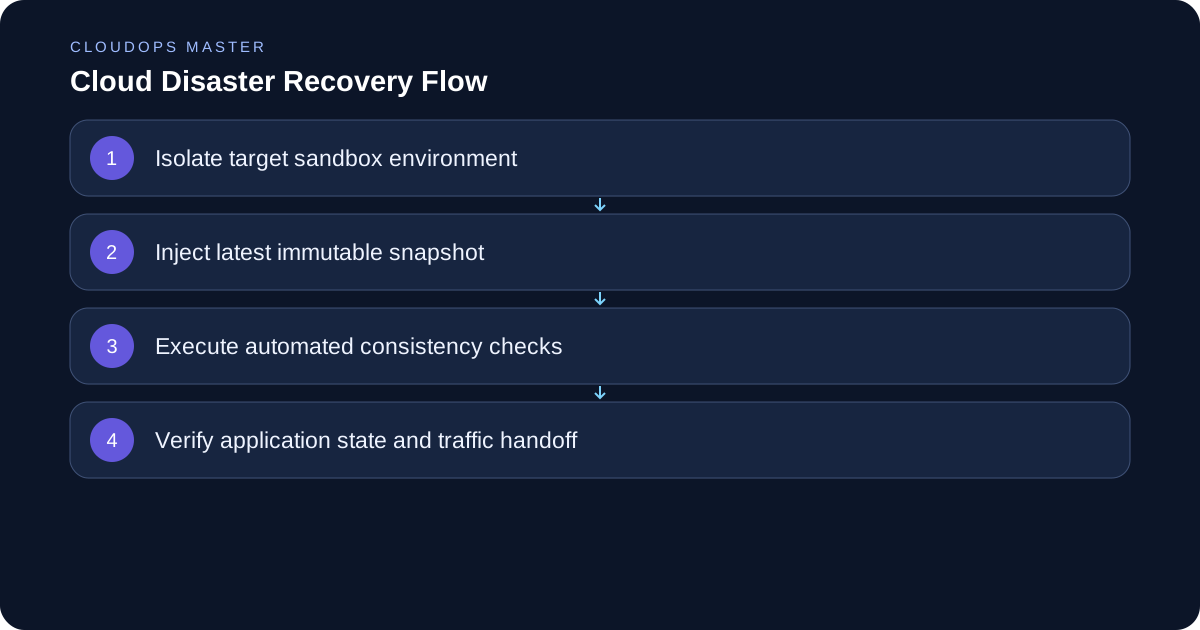
Maintaining cloud infrastructure requires treating backups as unverified hypotheses until proven otherwise through regular restoration routines. Many SaaS engineering teams invest heavily in automated snapshot schedules, replication rules, and long-term retention policies, yet fail to verify whether those bitstreams can resurrect a functioning database instance within acceptable operational limits. A disaster recovery plan that has never survived a live simulation is merely a collection of optimistic assumptions waiting to fail during an actual production outage. Building a resilient recovery strategy means shifting focus from mere data accumulation to rigorous, verifiable restoration mechanics.
The Restoration Reality Check and Common Failure Modes
The most common failure mode during a cloud outage is not data loss, but rather the discovery that the recovery process depends on undocumented tribal knowledge or manual steps. Engineers often assume that because a cloud provider reports daily snapshot completion, the underlying database schema, extensions, and configuration maps will align seamlessly upon rehydration. In practice, missing environment variables, stale infrastructure-as-code definitions, and unapplied migration scripts frequently block successful boot sequences. Furthermore, dependencies on external identity providers or proprietary KMS keys often break when targets are spun up in isolated recovery zones. Recognizing these failure points requires regular execution of recovery drills that test more than just raw storage recovery.
Designing an Isolated Sandbox for Restoration Drills
Executing a recovery test against production or staging environments introduces unacceptable risks of data corruption or accidental service disruption. Teams must provision an isolated, ephemeral sandbox environment that mirrors production topology without sharing active networking or security boundaries. This sandbox serves as a clean room where automated scripts can ingest snapshots, attach secondary storage volumes, and spin up compute instances. By maintaining strict isolation, engineers can measure real-world performance metrics without impacting live user traffic. When configuring this sandbox, ensure that access credentials and secret management systems are independently bootstrapped to prevent hidden dependencies on persistent production state.
Automating the End-to-End Recovery Pipeline
Manual recovery procedures are prone to human error, slow execution times, and panic during high-stress incidents. To achieve predictable recovery times, teams must codify the entire restoration sequence into automated pipelines. This involves scripting the extraction of the latest snapshot identifiers, provisioning the compute and networking layers via infrastructure-as-code, executing the database import routines, and launching health-check probes. Automation scripts should handle edge cases such as waiting for dependent services to become responsive before routing trial traffic. By turning recovery into a repeatable software deployment pipeline, operations teams remove uncertainty and drastically lower the barrier to running frequent, routine restoration tests.
Measuring Recovery Time and Point Objectives
Without empirical measurement, Recovery Time Objectives and Recovery Point Objectives remain arbitrary guesses written in compliance documents. Routine restoration tests provide the exact telemetry needed to validate these metrics under realistic load conditions. Teams should record the precise timestamp when a disaster scenario is triggered, track the duration of each phase in the restoration pipeline, and note the exact age of the restored data payload. If the test reveals that recovery takes four hours instead of the targeted one hour, engineers can systematically investigate bottlenecks—such as slow network throughput during snapshot downloads or unoptimized database index rebuilds—and refactor the recovery workflow accordingly.
Production Backup Restoration Checklist
- Define explicit Recovery Time Objective and Recovery Point Objective targets based on business criticality.
- Provision a completely isolated sandbox environment for running routine recovery simulations.
- Automate snapshot selection, infrastructure provisioning, and data import via version-controlled scripts.
- Execute scheduled drills without prior warning to test team readiness and runbook accuracy.
- Measure total elapsed time and data freshness during every restoration run to identify performance bottlenecks.
Conclusion
Cloud backup restoration is not a passive insurance policy; it is an active engineering discipline that demands continuous validation. By abandoning blind trust in automated storage snapshots and embracing rigorous, automated sandbox drills, SaaS teams can transform theoretical disaster recovery plans into dependable operational capabilities. Regular testing uncovers hidden configuration gaps, validates critical RTO and RPO targets, and ensures that when unexpected failures strike, the engineering organization can restore full service stability with absolute confidence.