Most engineering teams maintain robust backup routines for their cloud databases and object stores, yet many fail to verify whether those backups can actually be restored successfully. A backup policy without routine recovery testing is merely an unverified hypothesis. In cloud environments spanning multiple regions and complex dependencies, assuming data integrity based solely on completion logs is a critical operational risk. This guide explores how to design, automate, and execute practical backup restoration tests for modern SaaS architectures.
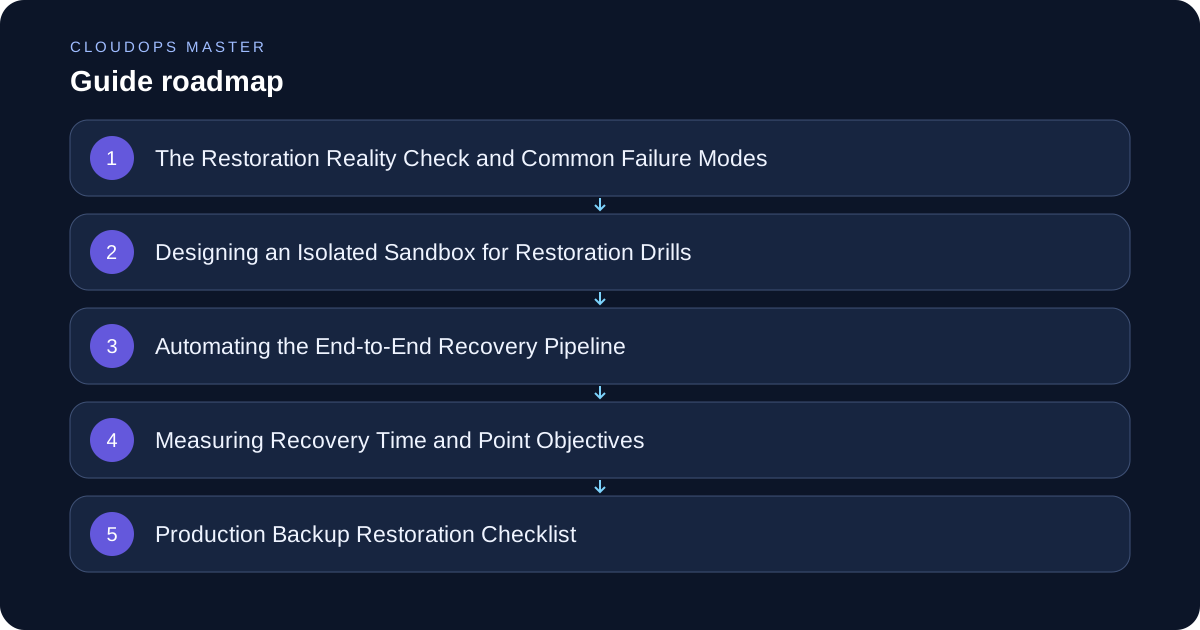
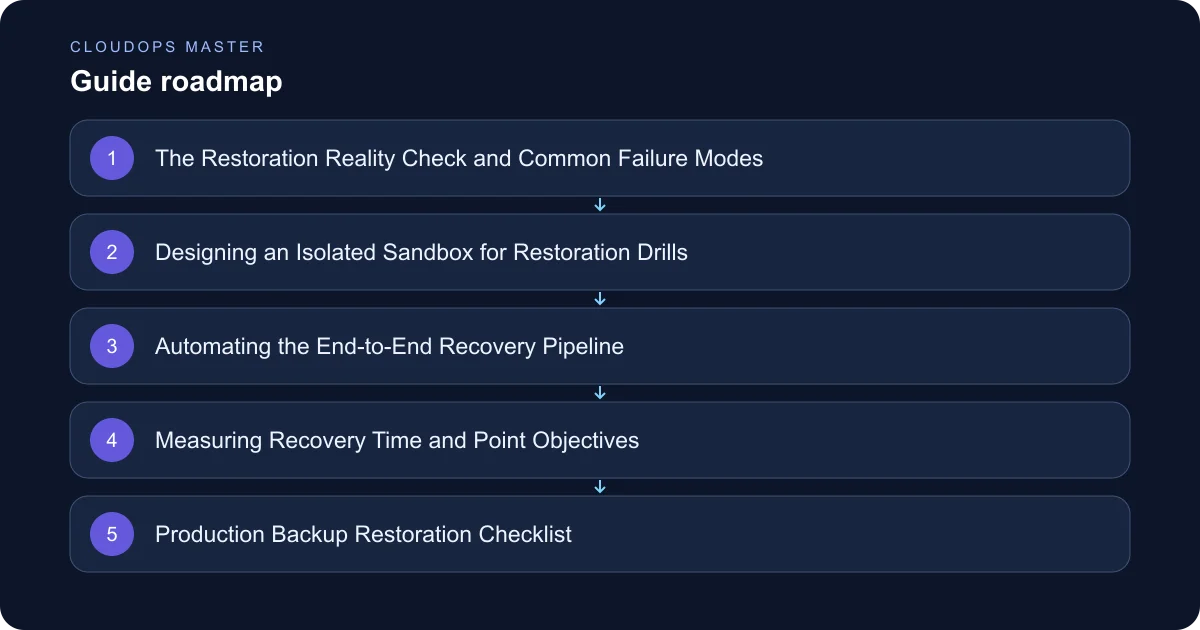
The Restoration Reality Check and Common Failure Modes
Backup jobs often report success while capturing incomplete states, corrupted index files, or missing cryptographic keys. When disaster strikes, teams discover that their restoration procedures rely on manual steps known only to departing engineers, or that dependencies like secret manager values and network policies were excluded from the snapshot scope. A reliable recovery process must account for schema evolution, permission boundaries, and orphaned storage volumes that fail to attach cleanly in target environments. Understanding these failure modes helps teams shift from passive data hoarding to active reliability engineering.
Designing an Isolated Sandbox for Restoration Drills
Testing restorations inside production or staging clusters introduces unacceptable risks of data overwriting and security exposure. Instead, engineering teams should provision ephemeral sandbox environments using Infrastructure as Code. This isolated target must mirror production network topologies, access control policies, and storage configurations closely enough to validate the restore process, yet remain completely firewalled from live traffic. Ephemeral validation stacks also allow teams to run automated integration tests against the restored data to ensure application compatibility before considering the drill complete.
Automating the End-to-End Recovery Pipeline
Manual restoration drills suffer from irregular execution schedules and human error. To maintain operational readiness, teams should script the entire recovery workflow. This pipeline must programmatically fetch the latest verified backup artifact, provision the isolated testing infrastructure, inject the snapshot into the target database or object store, and execute smoke tests against the restored endpoints. Scheduling this automation to run weekly or monthly ensures that silent configuration drift between your infrastructure code and backup snapshots is caught immediately rather than during an outage.
Measuring Recovery Time and Point Objectives
Execution speed matters just as much as data integrity during a catastrophic event. Backup restoration tests provide the only reliable method to measure Recovery Time Objective and Recovery Point Objective empirically. By timing each phase of the automated pipeline—from initial artifact download to final application readiness—engineers can identify bottlenecks such as slow network throughput during snapshot downloads or lengthy index rebuilds. Tracking these metrics over time establishes realistic service level agreements and highlights when storage tiers require optimization.
Production Backup Restoration Checklist
- Schedule automated weekly restoration drills into isolated sandbox environments.
- Verify that encryption keys and secrets required for decryption are securely backed up alongside data.
- Measure and record actual Recovery Time Objective and Recovery Point Objective metrics during every test.
- Implement post-restore integration tests to validate application functionality and data consistency.
- Document all manual workarounds encountered during testing and convert them into automated code.
- Restrict access to restoration pipelines using strict role-based access control and audit logging.
Conclusion
Backups are only as valuable as your ability to restore them under pressure. By moving away from manual, ad-hoc recovery attempts toward automated, frequent restoration drills, engineering teams can eliminate uncertainty and guarantee operational resilience. Treat every backup as untrusted until proven otherwise through systematic verification, and ensure your disaster recovery strategy stands ready for the unexpected.