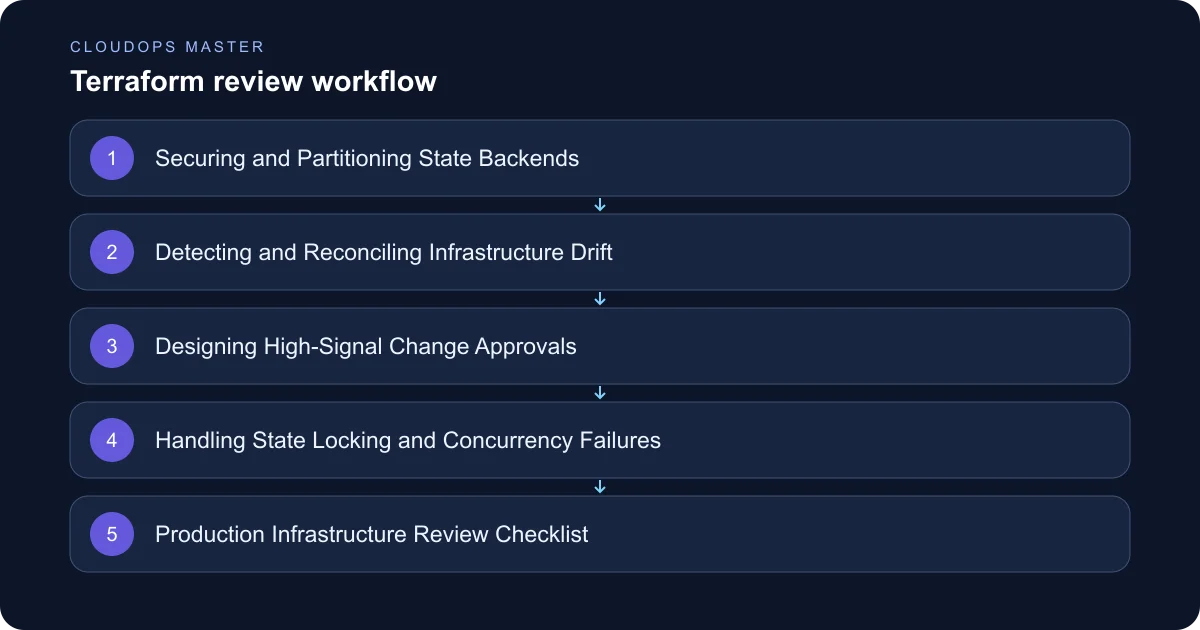
Managing infrastructure as code at scale requires rigorous governance around state files, detection of out-of-band changes, and strict change approval mechanisms. As SaaS platforms grow, manual checks fail and drift silently degrades environment reliability. This guide outlines practical patterns for maintaining clean state management, identifying configuration drift early, and ensuring that every production mutation undergoes adequate technical review.
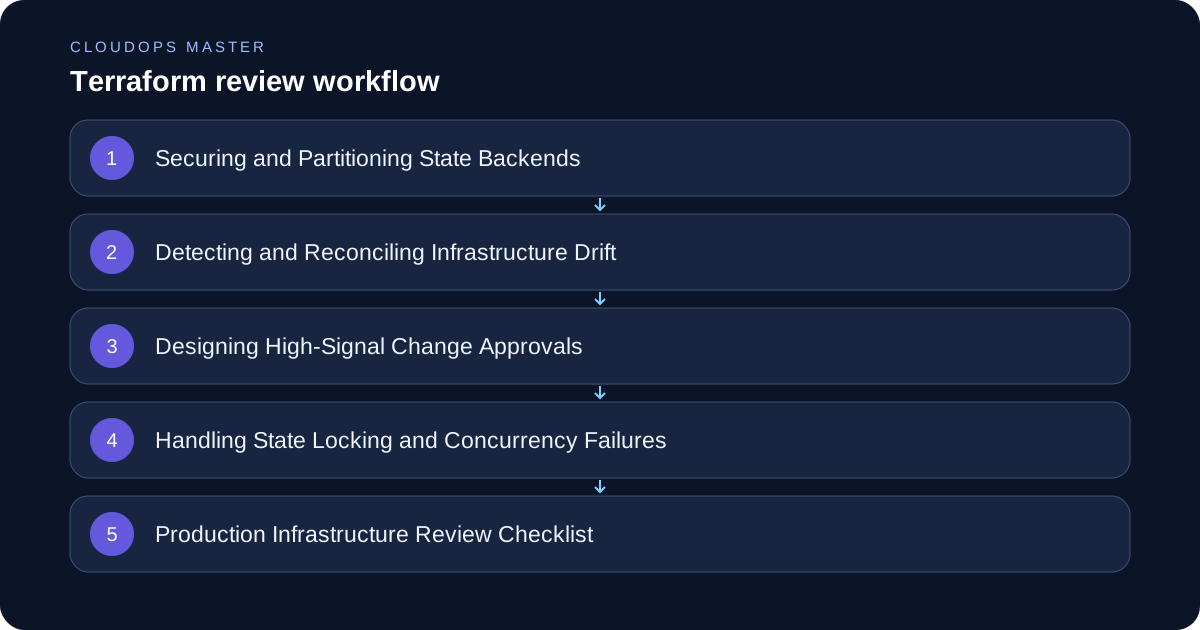
Securing and Partitioning State Backends
The foundation of reliable infrastructure automation is the secure storage and handling of state files. Storing state locally or in shared, unencrypted buckets introduces catastrophic risks of secret exposure and concurrent write corruption. Production teams must enforce remote backends with encryption at rest and in transit, combined with strict access control policies.
Partitioning state into logical domains prevents blast radiuses from expanding during failures. Monolithic state files that contain networking, database clusters, and stateless application compute together create severe bottlenecks and long plan execution times. Split configurations by lifecycle, risk level, and team ownership. However, avoid over-fragmenting into hundreds of tiny state files, which complicates cross-stack referencing through outputs and increases maintenance overhead.
Detecting and Reconciling Infrastructure Drift
Infrastructure drift occurs when the actual state of cloud resources deviates from the defined configuration due to manual emergency fixes, console clicks, or automated external services. Relying purely on scheduled apply runs is insufficient because standard execution plans may fail to capture subtle permission changes or resource modifications.
Implement automated, read-only drift detection pipelines that execute regular plan operations against target environments without applying changes. Route these validation alerts to engineering notification channels or ticketing systems when unauthorized modifications appear. When reconciling drift, always analyze the root cause before blindly overriding live resources. If a hotfix was applied directly to a production database instance, update the codebase first rather than forcing a destructive rollback that overwrites the emergency remediation.
Designing High-Signal Change Approvals
Pull request reviews for infrastructure code differ significantly from application code reviews. Reviewers must understand cloud provider nuances, IAM permission scopes, and the side effects of resource recreation. A common anti-pattern is rubber-stamping changes because the plan output contains hundreds of lines of noise.
To build high-signal reviews, require automated plan comments on pull requests that explicitly highlight dangerous actions such as resource destruction, data store replacement, or permission escalations. Configure CI systems to fail pull requests if critical resources are marked for replacement without explicit flags or secondary approvals. Establish clear ownership boundaries using code ownership rules so that database modules require sign-off from data platform engineers.
Handling State Locking and Concurrency Failures
Concurrent modifications to the same state file lead to corruption and permanent resource divergence. Remote backends must enforce atomic state locking to prevent parallel execution of apply operations. Despite this safeguard, abandoned locks caused by interrupted CI jobs or crashed runner instances frequently block deployments.
Teams must establish safe protocols for breaking locks. Before releasing a lock, verify through cloud console checks and runner logs that an active apply process is not currently modifying resources. Document emergency runbooks for state manipulation commands such as state unlinking, importing, and force-unlocking, restricting execution permissions to senior platform engineers.
Production Infrastructure Review Checklist
- Enforce remote encrypted state backends with strict identity-based access policies and audit logging enabled.
- Split large monolithic states into modular domains based on resource lifecycle and ownership boundaries.
- Schedule automated, read-only drift detection checks that alert engineering teams to out-of-band changes.
- Configure CI pipelines to block merges on destructive operations unless accompanied by explicit approvals.
- Implement atomic state locking and maintain clear operational runbooks for resolving abandoned locks safely.
- Mandate peer review for all infrastructure changes, focusing specifically on forced resource replacements and IAM updates.
Conclusion
Maintaining predictable cloud infrastructure requires discipline around state hygiene, continuous drift monitoring, and thoughtful change control processes. By treating infrastructure code with the same rigor as core application code, engineering teams prevent silent outages and maintain absolute clarity over their production environments. Balance automation with mandatory review gates to scale cloud operations safely without introducing unnecessary friction.