Introduction
Cloud cost optimization frequently degrades system reliability when teams execute reductions based purely on gross monthly totals. Aggressive downsizing, indiscriminate reservations, and unvalidated resource termination often trigger latent latency spikes, cascade failures, or unexpected performance degradation during peak traffic intervals. Sustainable financial engineering requires comprehensive baseline measurement before any destructive refactoring occurs. This article outlines the essential telemetry, dependency mappings, and utilization baselines engineering teams must capture to optimize cloud expenditures without compromising production stability.
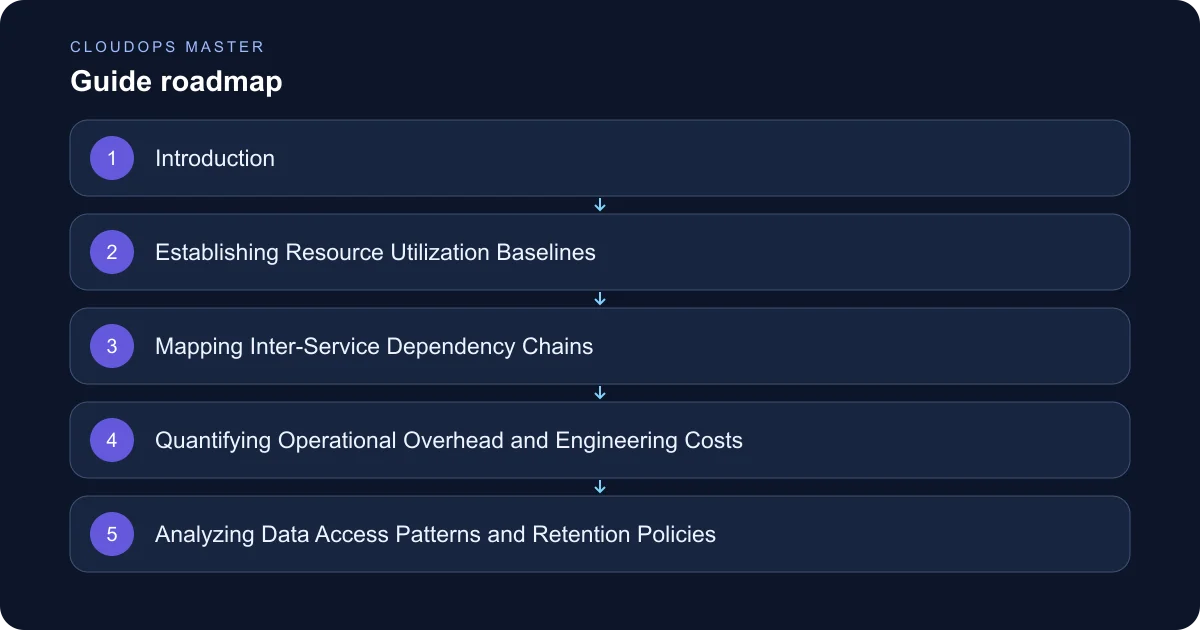
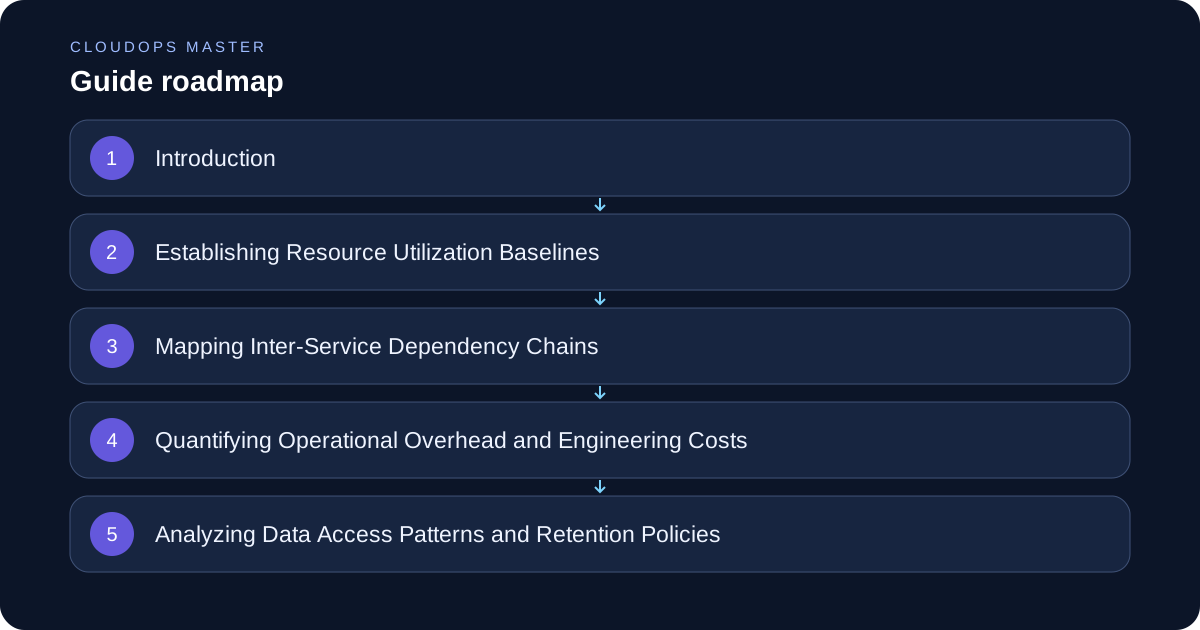
Establishing Resource Utilization Baselines
Raw cost allocation dashboards rarely reflect actual infrastructure efficiency. Before adjusting instance sizes or modifying storage tiers, teams must aggregate fine-grained resource utilization metrics over complete operational cycles. For compute workloads, this involves capturing CPU utilization distributions, memory saturation metrics, disk IOPS, and network throughput at granular intervals.
A single weekly traffic peak can invalidate average utilization metrics. Teams must analyze P95 and P99 resource utilization patterns rather than relying on arithmetic means. If an application utilizes 15 percent of its allocated memory on average but experiences a 95 percent saturation spike during batch processing jobs, standard downscaling will inevitably trigger out-of-memory errors.
Mapping Inter-Service Dependency Chains
Cloud infrastructure is rarely isolated. Modifying the SKU or regional deployment of a single database instance can inadvertently introduce network latency across dozen dependent microservices. Before undertaking optimization, teams must construct accurate dependency maps.
Network telemetry and distributed tracing data reveal hidden synchronous dependencies. If a high-throughput ingestion pipeline communicates with a secondary storage tier across availability zones, migrating that storage tier to a cheaper instance type with lower network bandwidth limits will cause immediate throttling. Understanding these cross-resource bottlenecks prevents localized financial savings from generating system-wide latency.
Quantifying Operational Overhead and Engineering Costs
Financial optimization efforts incur hidden operational expenses that frequently outweigh nominal infrastructure savings. Migrating a monolithic database to a distributed, multi-region architecture to leverage spot instances or tiered storage introduces significant maintenance overhead.
Engineering teams must calculate the total cost of ownership, factoring in the time required to manage complex custom tooling, troubleshoot transient instance interruptions, and handle fallback scenarios. If saving a few hundred dollars per month requires dozens of engineering hours to maintain brittle automation scripts, the optimization effort operates at a net loss.
Analyzing Data Access Patterns and Retention Policies
Storage expenditures often account for substantial portions of enterprise cloud bills, yet many organizations lack visibility into data access velocity. Before migrating volumes to cheaper archive tiers or implementing aggressive lifecycle policies, teams must analyze read and write frequencies.
Cold storage tiers typically impose retrieval fees and latency penalties. If an application unexpectedly requests archived telemetry data to satisfy an audit or real-time query, retrieval costs can rapidly eclipse the savings gained from storing the data cheaply. Detailed access logging ensures that lifecycle policies align with actual application behavior rather than theoretical assumptions.
Pre-Optimization Checklist
- Capture P95 and P99 resource utilization metrics across a full business cycle.
- Map all synchronous and asynchronous inter-service dependencies.
- Audit data access frequencies and retrieval latency requirements.
- Calculate engineering overhead versus projected financial savings.
- Identify critical path workloads that are exempt from automated scaling or termination.
- Establish automated alerting for performance degradation following resource modifications.
Conclusion
Effective cloud cost optimization is an engineering discipline anchored in measurement and risk management, not a simple exercise in turning off idle resources. By rigorously establishing utilization baselines, understanding intricate dependency networks, and factoring in total operational overhead, SaaS and engineering teams can reduce infrastructure spend safely. Measuring first ensures that financial efficiency never comes at the expense of system resilience.