Introduction
Releasing software to production without validating cloud identity and access management (IAM) permissions introduces severe architectural and security risks. Too often, engineering teams attach overly permissive roles to application workloads, leaving cloud resources exposed to lateral movement or data exfiltration if a vulnerability is exploited. Before any production release, a structured IAM audit must occur to enforce the principle of least privilege. This article outlines a rigorous technical process for identifying identity drift, pruning excessive permissions, and automating continuous policy validation within your delivery pipeline.
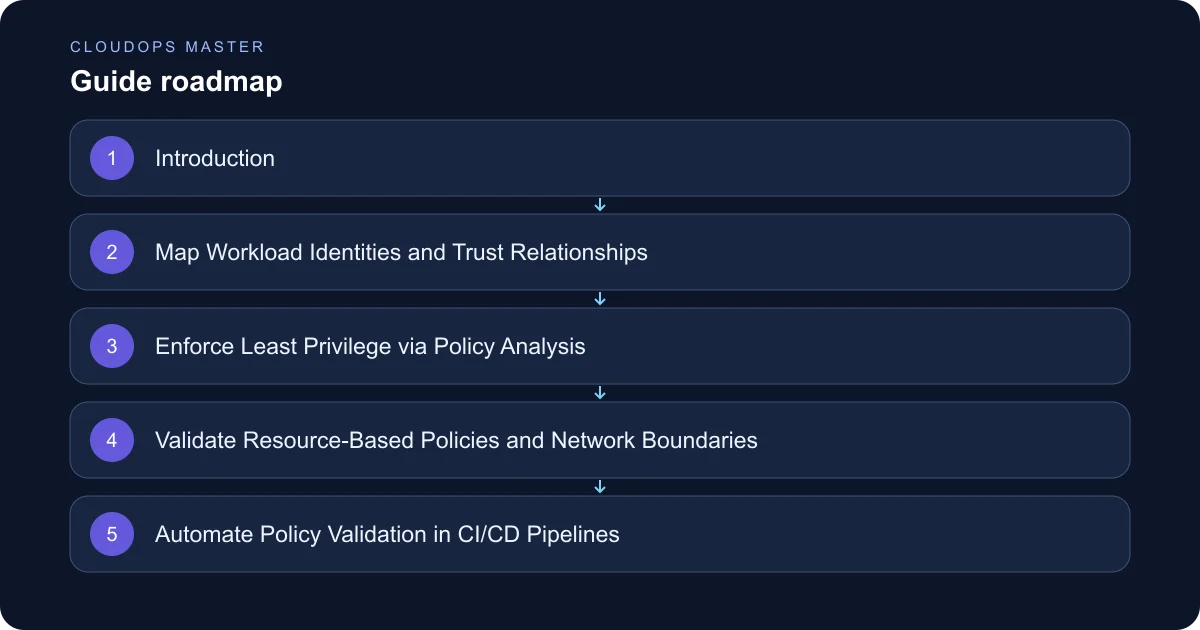
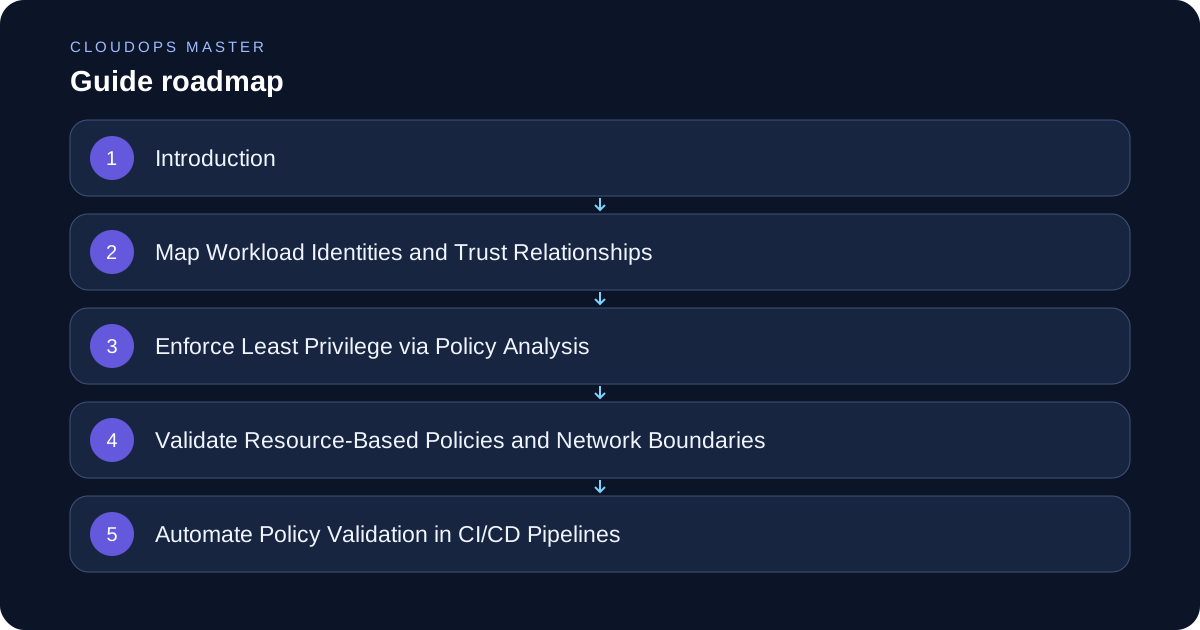
Map Workload Identities and Trust Relationships
The first step in any production IAM audit is mapping every service account, assumed role, and associated trust relationship. Applications rarely operate in isolation; they interact with managed databases, object storage, secrets managers, and message queues. You must document exactly which principals assume which roles and under what conditions.
Inspect your trust policies to ensure that assumption is strictly bounded. For example, verify that cross-account access or OIDC federations rely on strict audience claims and external IDs rather than wildcard trust relationships. If a workload can be assumed by any service within a broader organizational unit, the blast radius of a compromised component extends across the entire infrastructure.
Enforce Least Privilege via Policy Analysis
Once identities are mapped, evaluate the active permission boundaries attached to them. Over time, developers frequently add wildcard permissions like * on critical resource actions to unblock local testing or resolve unexpected runtime errors. These wildcards must be systematically identified and replaced with exact resource ARNs.
Conduct static analysis of your Infrastructure as Code (IaC) templates using policy linting tools. These tools flag overly broad statements before deployment occurs. However, static analysis alone is insufficient because it cannot predict runtime dependencies. Combine policy linters with historical access logs to see which permissions have actually been utilized over a designated window, such as the last thirty days. If an action has not been called in production during that period, remove it from the policy.
Validate Resource-Based Policies and Network Boundaries
Identity-based policies tell you what a principal can do, but resource-based policies—such as storage bucket access control lists, key management service policies, and database security groups—dictate who can access specific assets. A secure identity policy can be completely undermined by a public resource policy.
During your pre-release audit, cross-reference identity permissions with resource-level restrictions. Ensure that data stores, cache layers, and sensitive configuration stores explicitly deny unencrypted traffic and reject connections originating outside designated Virtual Private Clouds or peered networks. Defense-in-depth requires that even if an IAM role is inadvertently over-provisioned, network and resource boundaries prevent unauthorized access.
Automate Policy Validation in CI/CD Pipelines
Manual audits do not scale. To maintain hygiene across rapid release cycles, integrate automated IAM validation directly into your continuous integration and continuous deployment pipelines. Every pull request modifying cloud resources or IAM policies should trigger automated evaluation scripts.
Implement policy-as-code frameworks that evaluate Terraform plans, Kubernetes manifests, or cloud formation templates against organizational compliance rules. If a proposed change introduces a privilege escalation vector—such as allowing a role to grant permissions to itself or attach arbitrary policies—the pipeline must fail automatically. This shifts security left, preventing insecure configurations from ever reaching staging or production environments.
Production IAM Audit Checklist
- Map all service identities, roles, and trust relationships involved in the release.
- Remove all wildcard actions (
*) and resource restrictions that violate least privilege. - Cross-reference identity policies with resource-based access controls and bucket policies.
- Verify that external federations and OIDC trust configurations utilize strict audience conditions.
- Integrate automated policy linting and policy-as-code checks into the CI/CD pipeline.
- Review historical cloud trail logs to prune unused permissions from legacy workloads.
- Document exception workflows and ensure temporary elevated privileges have strict expiration timers.
Conclusion
Auditing cloud IAM permissions before a production release is a fundamental operational requirement for modern SaaS engineering teams. Relying on default settings or leaving broad wildcard policies in place invites operational disruption and security breaches. By systematically mapping trust relationships, enforcing strict least privilege, validating resource boundaries, and embedding automated checks into your delivery pipelines, you significantly reduce your infrastructure risk profile. Treat IAM policies with the same rigorous review process applied to core application code, ensuring your cloud environment remains resilient, auditable, and secure.