Long-lived access keys stored as static pipeline secrets represent one of the most critical blast radius multipliers in modern software delivery. When an infrastructure provisioning workflow or deployment agent relies on a permanent IAM user key, a single compromised build artifact or log leak can grant persistent, unmonitored access to cloud environments. Eliminating these long-lived credentials requires transitioning to identity federation and ephemeral security tokens that expire automatically after a build job finishes. This architectural shift demands careful planning around trust policies, token lifespans, and fallback mechanisms when identity providers experience downtime.
The Hidden Risk of Static Pipeline Secrets
Traditional continuous integration workflows often rely on environment variables populated with persistent cloud credentials. While straightforward to configure, these static secrets bypass standard credential rotation policies because developers rarely remember to update tokens stored inside build runners. Furthermore, third-party test runners, open-source dependency scanners, and build cache systems frequently log environment variables during unexpected failures. If a build log exposes a permanent secret, remediation requires immediate key revocation, permission auditing, and thorough log scrubbing across all artifact repositories. Moving away from static secrets reduces operational anxiety and closes a common vector for credential exfiltration.
Implementing OpenID Connect Federation
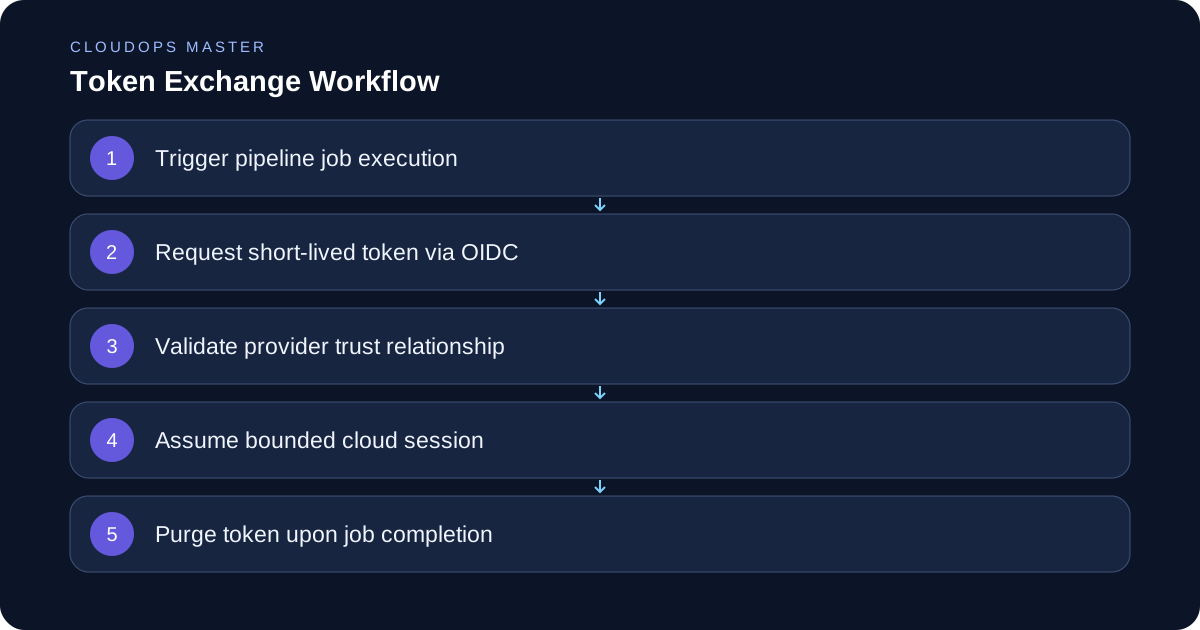
Modern cloud providers support OpenID Connect authentication, enabling continuous integration pipelines to trade cryptographic JSON Web Tokens for temporary session credentials. Instead of storing a secret key, the pipeline runner requests an identity token from the CI/CD platform and presents it directly to the cloud provider. The cloud IAM service validates the issuer, the repository name, and the specific branch or tag before issuing temporary credentials constrained to a narrow timeframe. This approach ensures that even if an attacker intercepts a build trace, the token has already expired or lacks permissions outside the active deployment scope. However, teams must configure trust policies precisely to prevent unauthorized repositories within the same organization from assuming privileged roles.
Scoping Ephemeral Permissions for Deployments
Transitioning to short-lived tokens is only half the battle; those tokens must adhere strictly to the principle of least privilege. Many engineering teams mistakenly map broad administrative policies to temporary federated roles just to avoid deployment friction. A deployment role used for container registry pushes should never possess permissions to modify core networking infrastructure or IAM policies. By scoping ephemeral sessions to specific resource ARNs and enforcing condition keys that restrict execution based on repository attributes, teams can ensure that compromised build pipelines can only affect designated staging or production environments. This granularity limits the blast radius of any security incident involving compromised runner infrastructure.
Handling Multi-Account and Cross-Environment Topologies
Enterprise software architectures frequently span multiple cloud accounts separating staging, production, and shared services. Managing federated access across these boundaries requires a chained assumption model where the initial OIDC token assumes a staging role, which may then conditionally assume a downstream production role if explicit manual approvals pass. Pipeline configurations must handle token expiration gracefully, implementing retry logic and exponential backoff if the identity provider experiences transient throttling. Engineers must also monitor session duration limits imposed by cloud providers, ensuring that long-running database migrations or large infrastructure plans do not fail midway due to token timeout.
Production Credential Security Checklist
- Audit all existing CI/CD secret stores and identify every permanent cloud credential.
- Establish OpenID Connect trust relationships between the CI/CD provider and the cloud environment.
- Replace static environment variables with dynamic token generation steps in workflow files.
- Restrict federated IAM roles using resource-level permissions and condition keys.
- Configure automated alerts for anomalous role assumption patterns or failed authentication attempts.
- Implement strict session timeout limits aligned with average job execution durations.
Conclusion
Eliminating long-lived credentials from continuous integration pipelines is a fundamental requirement for mature cloud operations. By replacing static access keys with OpenID Connect federation and strictly scoped ephemeral sessions, engineering teams can drastically reduce their vulnerability surface area. While adopting identity federation introduces initial configuration overhead and requires careful policy management, the long-term security posture improvements far outweigh the setup effort. Secure pipelines protect organizational infrastructure, maintain compliance standards, and allow engineering teams to ship software with confidence.