Alert fatigue remains one of the primary drivers of engineer burnout and silent production outages. When an on-call rotation receives dozens of unactionable pages daily, critical signals blend into the background noise. Modern SaaS infrastructure requires a deliberate approach to observability, shifting away from resource-exhaustion metrics toward user-centric symptoms. This article explores how to architect a high-signal alerting strategy that protects operational health without eroding team morale.
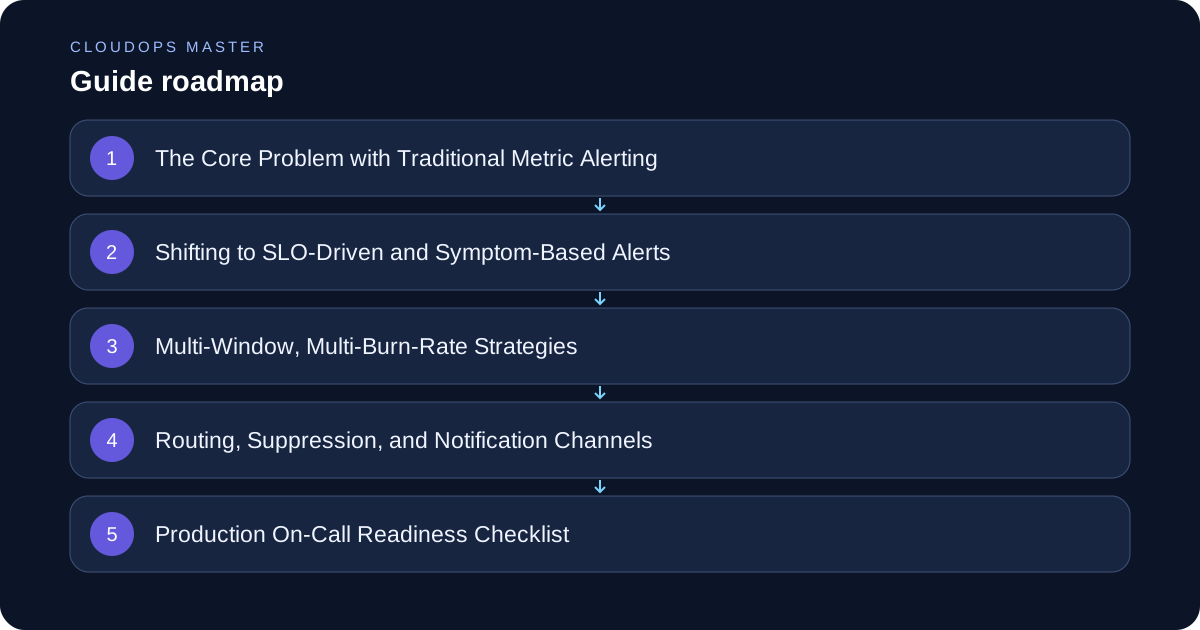
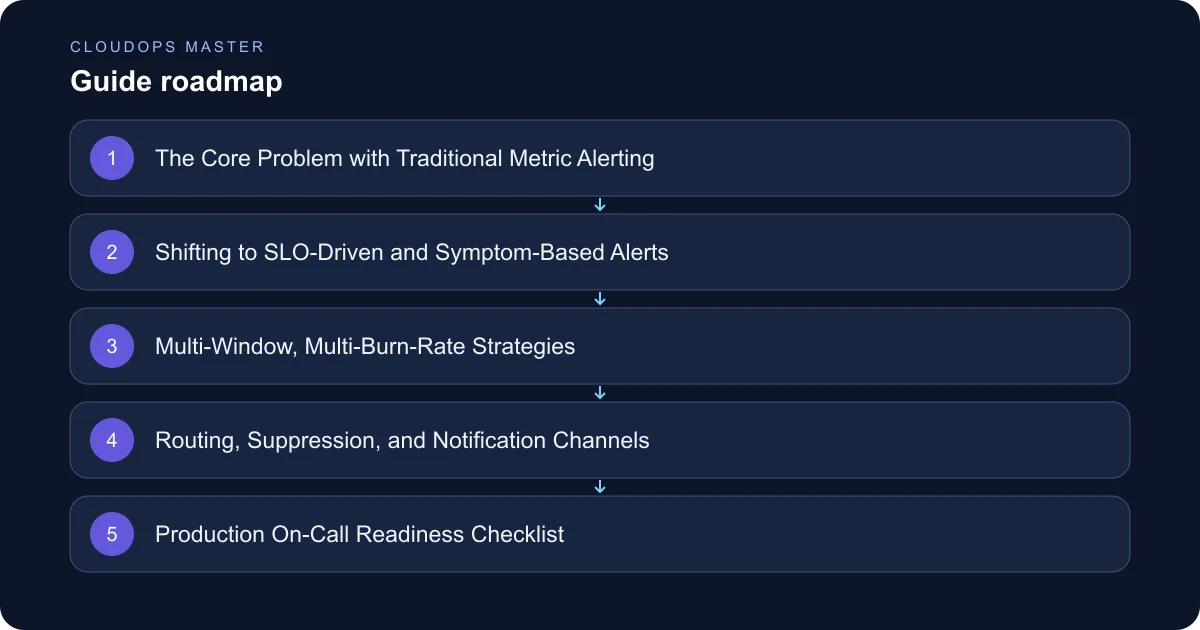
The Core Problem with Traditional Metric Alerting
Traditional infrastructure monitoring often relies on static thresholds for CPU usage, memory consumption, or disk utilization. While these metrics provide historical context, they rarely correlate directly with user impact. An instance running at 95 percent CPU utilization is not an incident if requests are completing successfully within latency SLOs. Conversely, a service returning HTTP 500 errors due to a database deadlock might fly under the radar if CPU utilization remains modest.
Relying on raw resource metrics creates false positives that train engineers to ignore notifications. When every infrastructure bump triggers an urgent page, on-call personnel develop defensive habits, such as muting channels or ignoring pages until secondary verification arrives. This dynamic destroys the integrity of the escalation path and increases mean time to recovery when real failures occur.
Shifting to SLO-Driven and Symptom-Based Alerts
Service Level Objectives provide the mathematical foundation for sustainable alerting. Instead of alerting when a resource is stressed, alert when the user experience degrades beyond an acceptable threshold. Symptom-based alerting focuses on the output of the system—what the user or downstream consumer experiences—rather than the internal state of individual components.
When designing these rules, measure availability and latency. For example, rather than paging on high memory consumption in a worker node, page when the queue processing duration breaches a boundary that threatens the daily completion window. This isolates the alert to actual business logic failures. Tradeoffs exist: symptom-based alerts can occasionally obscure the root cause, requiring engineers to dig deeper into tracing tools, but they drastically reduce false positives by filtering out self-healing infrastructure events.
Multi-Window, Multi-Burn-Rate Strategies
To balance urgency with accuracy, adopt multi-window, multi-burn-rate alerting models popularized by Site Reliability Engineering frameworks. Instead of a single threshold, calculate how quickly your error budget is depleting over different time horizons.
A fast burn rate—such as exhausting two percent of an error budget in five minutes—warrants an immediate page because the system is experiencing a severe outage. A slow burn rate—such as exhausting ten percent over twenty-four hours—should generate a ticket for the next working day rather than waking an engineer at midnight. This nuance prevents alert storms during minor, self-resolving network blips while catching slow degradations before they cause catastrophic failures.
Routing, Suppression, and Notification Channels
Not all notifications require human intervention. Establishing a strict hierarchy of severity levels ensures that messages reach the appropriate medium without unnecessary disruption:
- Pages: Reserved for active, unmitigated user-facing degradation requiring immediate manual intervention.
- Tickets: Created automatically for low-urgency anomalies, resource constraints, or slow error budget depletion.
- Logs and Dashboards: Passive repositories for transient errors that self-heal or require investigation only during post-mortems.
Suppressing noisy alerts during planned maintenance windows or known upstream dependencies is essential. However, avoid permanent suppressions for unresolved issues; instead, track them as technical debt items with assigned remediation deadlines.
Production On-Call Readiness Checklist
- [ ] Every alert correlates directly to a user-facing symptom or an imminent SLO breach.
- [ ] Static resource thresholds (CPU, RAM) are routed exclusively to non-urgent ticketing systems.
- [ ] Multi-window burn-rate logic is implemented for critical availability and latency metrics.
- [ ] Runbooks are linked directly within the notification payload with precise remediation steps.
- [ ] On-call rotations regularly review false-positive rates during retrospective meetings.
- [ ] Notification channels are segmented by severity into pages, tickets, and passive logs.
Conclusion
Designing effective alerts requires a cultural and technical shift away from infrastructure paranoia toward user-centric reliability. By focusing on symptoms, implementing multi-window burn rates, and enforcing strict routing hierarchies, engineering teams can eliminate noise and preserve the psychological safety of their on-call rotations. When alerts are rare, relevant, and actionable, engineers respond with speed and precision, transforming monitoring from a source of burnout into a reliable safeguard for production stability.