Small engineering teams often struggle with reliability management because enterprise Service Level Objective frameworks assume dedicated site reliability engineering staff. When four developers manage a sprawling SaaS architecture, adopting dozens of complex uptime targets creates immediate alert fatigue and administrative drag. Choosing practical SLOs requires a disciplined focus on user value rather than internal infrastructure vanity metrics. By limiting initial targets to core user journeys, small teams can maintain system health without sacrificing feature velocity.
The Trap of Infrastructure-Centric Targets
Many teams begin their reliability journey by measuring CPU utilization, memory thresholds, and disk space across every virtual machine and container. While these metrics matter during incident triage, they do not reflect actual customer experience. An application can have ninety-nine percent CPU usage while successfully processing every user request, or it can sit completely idle while failing to connect to the database. Practical SLO selection starts by ignoring internal resource gauges and focusing entirely on customer-facing endpoints.
Identifying Core User Journeys
A small team must ruthlessly prioritize which workflows deserve formal measurement. Review your application logs and transaction volumes to find the three most critical operations that generate revenue or support core product utility. For a typical SaaS application, these journeys usually include user authentication, primary data creation, and data retrieval. If authentication fails, the entire application is unusable. If a secondary reporting export fails, users can usually retry later without abandoning the platform. Limit your initial SLO count to these primary paths to keep operational overhead manageable.
Establishing Baselines from Reality
Never invent arbitrary targets such as four nines of availability when starting out. Review your existing monitoring data over the previous ninety days to determine your true historical performance. If your current architecture naturally delivers ninety-eight point five percent availability due to upstream provider dependencies or scheduled maintenance windows, setting an objective of ninety-nine point nine percent guarantees constant paging and immediate team burnout. Your initial SLO should reflect your current operational reality, leaving room for iterative improvements as infrastructure resilience hardens.
Managing Error Budgets and Burn Rates
An error budget represents the acceptable amount of unreliability your system can experience before user trust erodes. Instead of treating every minor glitch as an emergency, tie your alerts to error budget burn rates. If a rapid spike in failures threatens to consume the entire monthly error budget within a few hours, page the on-call engineer immediately. If the budget drains slowly over weeks, convert the issue into a backlog ticket for the next sprint. This prevents false alarms and keeps engineering focused on sustainable architecture.
Practical SLO Implementation Checklist
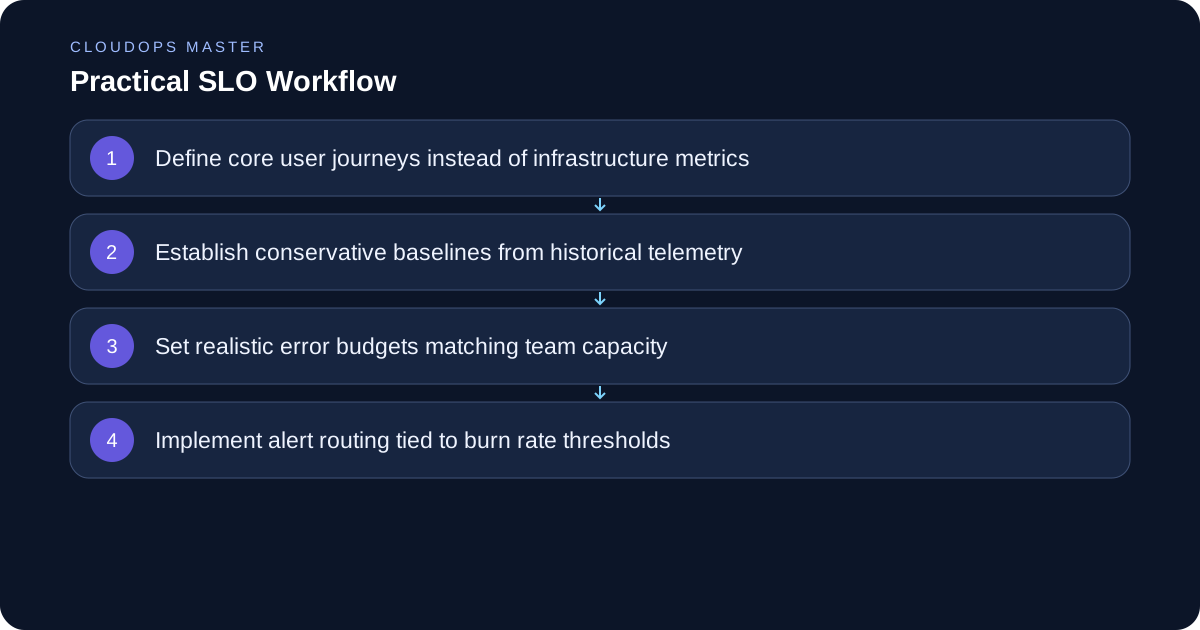
- Identify three core user journeys that directly impact customer success.
- Audit the last ninety days of telemetry to establish realistic baseline performance.
- Define error budgets that align with current deployment frequency and team size.
- Configure alert rules based on multi-window burn rates rather than static thresholds.
- Schedule a monthly review to adjust targets as system architecture evolves.
Conclusion
Selecting practical SLOs is an exercise in constraint management for resource-constrained engineering teams. By abandoning complex enterprise frameworks and focusing strictly on core user journeys, small groups can achieve high reliability without sacrificing delivery speed. Start small, base your targets on historical telemetry, and treat error budgets as guide rails for sustainable software delivery.