Choosing the right deployment architecture is one of the most consequential decisions a growing SaaS engineering team can make. The industry pendulum often swings wildly between treating Kubernetes as an architectural silver bullet and dismissing it as over-engineering. In reality, platform choices should be dictated by technical constraints, organizational maturity, and product scale rather than resume-driven development.
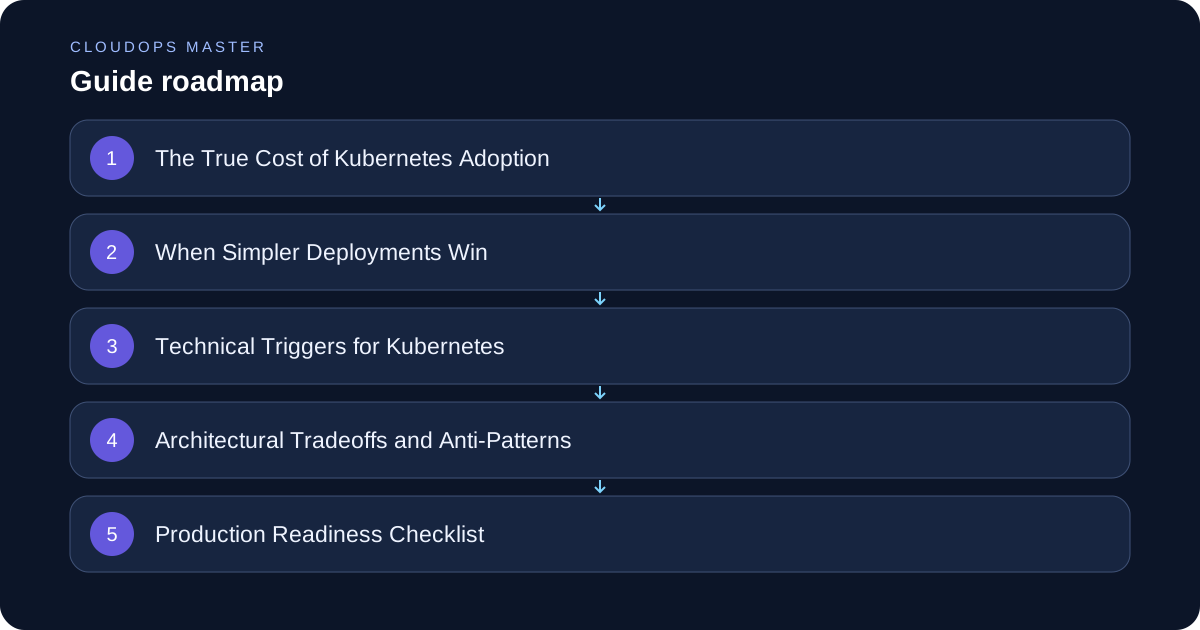
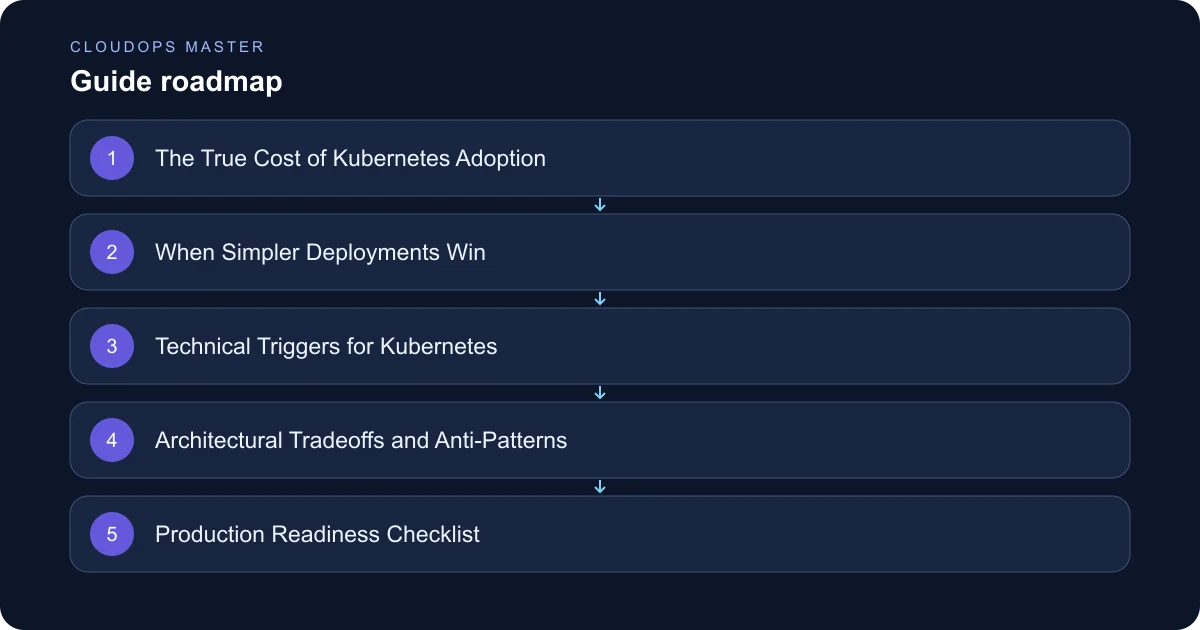
The True Cost of Kubernetes Adoption
Kubernetes offers an unmatched declarative API for managing containerized workloads at scale, but it introduces a steep learning curve and continuous operational overhead. Running a production-grade cluster requires dedicated expertise in cluster upgrades, etcd maintenance, networking plugins, and security hardening. For smaller teams, this tax often translates into engineers spending valuable cycles debugging control plane issues instead of shipping product features.
Furthermore, managed Kubernetes services reduce operational burden, but they do not eliminate it entirely. Node sizing, cluster autoscaling tuning, and ingress controller management still demand deep technical proficiency. If your team lacks personnel with specialized infrastructure experience, adopting Kubernetes prematurely can introduce systemic stability risks.
When Simpler Deployments Win
For early-stage SaaS applications or monolithic architectures, simpler deployment models often deliver superior time-to-market. Platform-as-a-Service (PaaS) offerings, container instances, or simple virtual machines managed via configuration management tools provide predictable environments without the cognitive load of a container orchestrator.
Simpler setups shine when your application consists of a single monolithic binary or a small number of services. Deploying via rolling updates on managed container services or immutable virtual machine images abstracts away infrastructure complexity. This approach allows developers to focus entirely on application logic, CI/CD pipelines, and database optimization. The tradeoff is limited flexibility in fine-grained traffic routing and manual scaling configuration, which rarely bottlenecks early-stage growth.
Technical Triggers for Kubernetes
Transitioning to Kubernetes becomes justifiable when specific technical thresholds are crossed. These triggers are rarely about vanity metrics; they stem from architectural complexity and operational bottlenecks.
Consider adopting Kubernetes when you manage a sprawling microservices architecture where service discovery, inter-service authentication, and cascading failure isolation become unwieldy to handle via traditional load balancers. Another strong indicator is the need for multi-tenant isolation with strict resource quotas, or complex batch processing pipelines that require sophisticated job scheduling and bin-packing. If your infrastructure footprint demands automated self-healing across heterogeneous cloud regions with complex ingress rules, Kubernetes provides the exact primitives required to solve those challenges.
Architectural Tradeoffs and Anti-Patterns
Adopting Kubernetes solely to achieve zero-downtime deployments or horizontal autoscaling is an anti-pattern. Both capabilities can be achieved on simpler platforms with significantly less operational friction.
The primary architectural tradeoff lies between operational simplicity and fine-grained control. Simpler deployments trade away deep extensibility and advanced workload scheduling for predictable maintenance and low administrative overhead. Kubernetes trades away simplicity for near-infinite extensibility, custom resource definitions, and declarative infrastructure management.
When your organization has multiple autonomous product squads deploying independent services frequently, the lack of a standardized deployment contract becomes a bottleneck. In this scenario, Kubernetes acts as an internal developer platform that standardizes how applications are packaged, secured, and scaled.
Production Readiness Checklist
Before committing to a Kubernetes migration, engineering teams should evaluate their operational readiness against a concrete baseline:
- Infrastructure Competency: At least one engineer on the team has hands-on experience troubleshooting CNI plugins, DNS resolution, and certificate rotations in production.
- CI/CD Maturity: Automated pipelines exist that build, test, and package container images securely without manual intervention.
- Observability Stack: Centralized logging, distributed tracing, and metrics collection are fully operational prior to cluster deployment.
- Backup and Recovery: Automated, tested procedures exist for restoring etcd state and persistent volumes in a disaster recovery scenario.
- Security Baseline: Role-based access control, network policies, and secret management tools are configured and enforced.
Conclusion
Kubernetes is a powerful orchestration engine designed to solve complex distributed systems problems at scale. However, it is fundamentally an operational tax paid upfront for future architectural flexibility. Growing SaaS teams must rigorously weigh the complexity of cluster management against their actual product requirements. Often, starting with a simpler deployment model and migrating to Kubernetes only when architectural pain points demand it is the most pragmatic path to sustainable engineering growth.